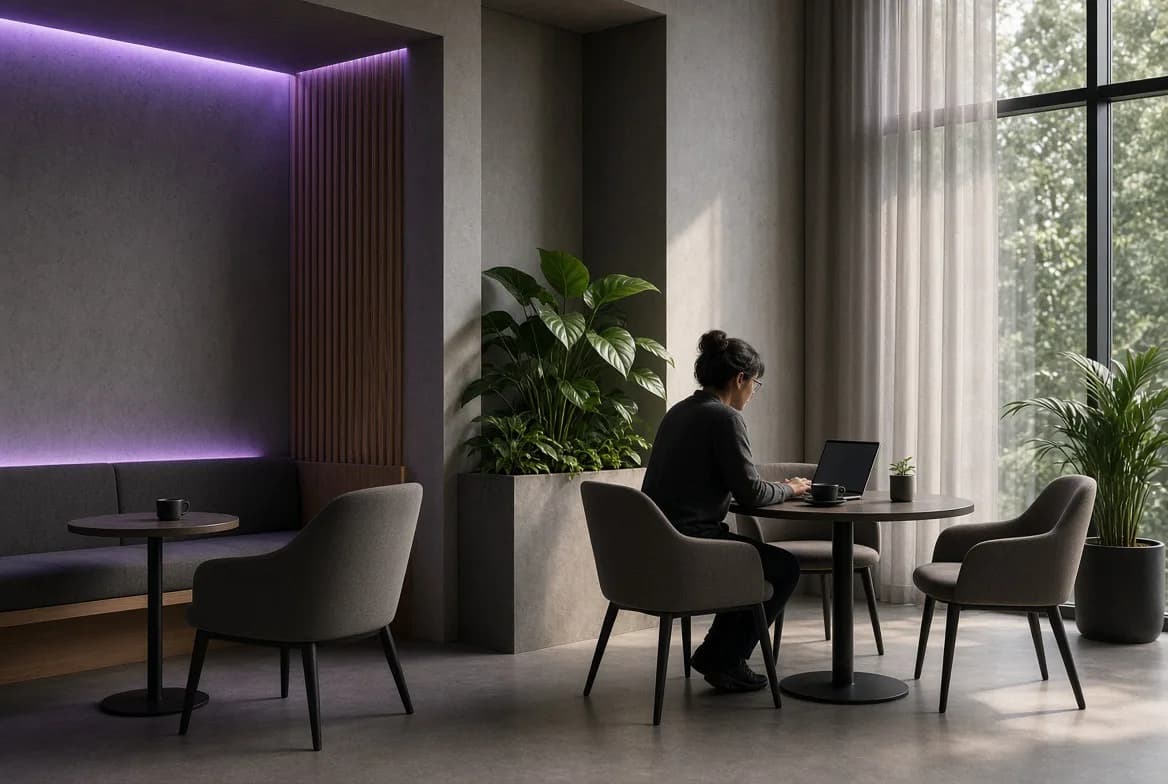
The place didn't change. You did. Your energy, your intention, the city's weather, even what you ate. And that matters more than we think.
Most of us keep choosing spaces as if they were fixed: the usual coworking, the corner café, the apartment table. Google Maps tells you where it's open and how far it is. It doesn't tell you if that place is aligned with what your brain needs today.
The environment isn't background. It's part of the work
Indoor Environmental Quality (IEQ) research is clear: temperature, ventilation, natural light, noise, and the presence of natural elements are not details. They directly influence attention, creativity, fatigue, and wellbeing.
Recent studies show that temperatures between 22 and 26 °C are associated with better cognitive performance. High CO₂ levels reduce attention and working memory. Noise above ~60 dBA starts to affect tasks that require concentration. Optimized natural light dramatically reduces visual fatigue and improves alertness.
It's not just comfort. It's biology. Your nervous system responds to the environment automatically. A space with good light and a bit of green restores you; a dark and noisy one drains you, even if you don't notice.
In Medellín this is especially noticeable. The city of eternal spring (around 20–24 °C most of the year) makes it easy to go out and work. But it also makes the differences between neighborhoods and between one café and another more subtle and, at the same time, more important. Laureles can feel more local and walkable; El Poblado more densely connected with other nomads. The same café can be ideal at 9 a.m. and heavy at 3 p.m. after the afternoon rain.
Why “the usual place” stops working
There are three main reasons:
Your state changes faster than the place. There are deep-work days and collaboration or recovery days. A space excellent for concentration can be the worst for a call or for simply not feeling alone.
Static maps don't see context. They know the address, the hours, and the average reviews. They don't know if it's full today, if the air conditioning is failing, if there's a group talking loudly, or if the afternoon light comes in perfectly. They also don't know how you are.
Attention restoration is real. Attention Restoration Theory shows that environments with “soft fascination”—plants, views, natural light, a certain level of coherence—help recover directed attention. A space that only offers noise and strong stimuli doesn't restore; it exhausts.
The result is familiar: you choose the comfortable place out of habit and end up with a day of half productivity, more fatigue than necessary, and the feeling that “today didn't work.”
How to choose according to the day, not the habit
It's not about changing places every day for sport. It's about having enough information to decide with clarity.
Some practical signals that people who work from different spaces learn to read:
High energy + need for deep focus: Look for natural light, little conversational noise, good ventilation. A corner with a view or a quieter space. In Medellín, cafés like Naturalia or Zeppelin in Laureles often offer that profile in the mornings.
You need collaboration or don't want to be alone: Places with more movement, shared tables, or spaces where people are already working (not just tourists). Pergamino or Semilla work well for that.
You're low on energy or recovering: Prioritize places with natural elements, soft light, less density. Sometimes a change of neighborhood or simply a café with plants and fewer people changes the rest of the day.
Climate and time of day: In Medellín, rainy afternoons change the dynamics of many cafés. A place that works perfectly in the morning can get saturated after lunch.
The point isn't to find the “best” place in the city. It's to find the place that fits your intention and your state in this moment.
What maps can't see (and the community can)
Google Maps is excellent for navigating. It's terrible for this. Because the real context of a space—noise level right now, quality of light, whether there are people working or just passing through, whether the air feels fresh—changes constantly and isn't on any static listing.
Only the person who's there, or who just left, knows that.
That's where a community network changes the game. When people report the real state of a space (noise, occupancy, energy, recent photos), the map stops being a list of addresses and becomes something alive. You can see not only “where there are cafés,” but “where there's a space that probably fits what you need now.”
It's not magic. It's contextual information put in the hands of the person who needs it. And in cities like Medellín, where the climate invites you out and there's a real density of cafés and workspaces, that difference is noticeable day to day.
The right place is the one that lets you thrive today
The usual place has its value. Familiarity reduces friction. But when it becomes the only option, you start working despite the environment instead of with it.
The science is consistent: the environment modulates your attention, your energy, and your ability to recover. In a world where many of us can choose where to work, ignoring that is leaving performance and wellbeing on the table.
The right place today may not be the usual one. And that's fine. The question isn't “where do I usually go?”. It's “where can I thrive today, with the energy and intention I have now?”.
When you have that clarity, the day changes. Not because the café is magic. Because the environment stopped being an invisible obstacle and became a conscious decision.

Be where you thrive.